
"A Private Discussion With Democracy"
A essay written by Joseph Goebbels on March 21st, 1939

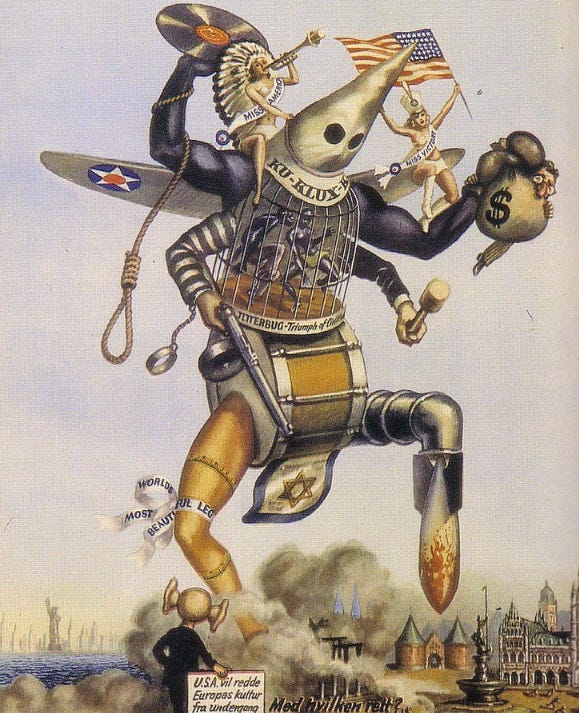
The shifts in the balance of power that have taken place in Central Europe over the past twelve months have caused considerable unease in the democracies of Western Europe - we are not cynical enough to pretend that we do not understand this, but we would be far more comfortable if democracy could at least muster enough honesty to state the true reasons for its discontent, rather than constantly bandying about moralistic platitudes; that would undoubtedly provide a much clearer and cleaner basis for international discourse than what currently seems to exist.
In London and Paris they speak of God and mean, to paraphrase the well-known saying about the English, cheap calico1 - and since we are on the subject of the English, allow us the polite aside that they are indeed particularly adept and truly famous at concealing their political motives, but unfortunately, that no longer works on us: we fell for it in November 1918, but that happens only once, and it won’t happen again!
We paid dearly for our credulity at the end of the war with a bitter period of suffering from 1918 to 1933, and we therefore find ourselves today in the role of the child who has been burned and now shuns the fire - it is therefore completely pointless for people in London and Paris to try to beat around the bush, and it would obviously be much more practical—and would only enhance the value of the discussion—if terms like humanity, civilization, international law, and international trust were finally removed from the public debate in this context.
We must admit that we cannot help but smile slightly when, of all places, the English press attempts with downright deadly seriousness to apply these terms to the conflict between democracy and authoritarian states - we can only say politely but firmly: allow us to chuckle loudly and audibly!
This may have worked on our bourgeois pre-war Germany, which was, after all, known for taking the rhetoric of democracy with deadly seriousness, and it may also have worked on our staid establishment figures and parliamentary philistines of the postwar era, but for us National Socialists, this line of argument has completely lost its appeal of novelty and originality; in fact, it lacks any credibility whatsoever.
We can only admire the downright provocative audacity with which these arguments are put forward in polemics - if the English have gradually developed a thick skin in these matters over the course of the centuries-long history of establishing and defending their empire, we can assure them, for their peace of mind, that based on our recent experiences in this regard, we too no longer have cause to complain; it would therefore be very refreshing and exceedingly pleasant if we would at least try to stop deceiving one another since we know each other, after all.
Let us, as honest men, look each other squarely in the eye—without any pious pretense—and finally, finally, call a spade a spade.
What, then, was actually planned and attempted in Versailles with regard to Central Europe? Germany had been brought to its knees, militarily disarmed, and economically plundered; its foreign assets and merchant fleet had been taken from it, and its colonies were torn from its sphere of influence.
The attempt to annex Austria to the Reich was branded an attack on European security, and the creation of the more than peculiar Czechoslovak state had no other purpose than to drive a stake right into Germany’s flesh and to establish a very convenient and cheap military staging ground against the Reich in Bohemia and Moravia - it was believed that this would not only definitively eliminate Germany from the international arena, but also keep it preoccupied with its own concerns for all time, for while German Austria was to serve as a perpetual bone of contention between the Reich and Western European democracy, and so-called Czechoslovakia was tasked with securing the military encirclement of the Reich and placing it on a firm footing.
What all this meant is nothing less than an attempt to perpetuate European tensions designed to keep the German giant—though completely crushed in its military defensive power, yet still threatening in its popular strength—occupied with itself and its own concerns.
This was extraordinarily practical and convenient for London, for it gave England a free hand to expand and defend its global empire; now it hardly needed to concern itself with the balance of power in Europe, since Germany was completely sidelined from the international power struggle as a result of constantly increasing Central European tensions.
The Reich had the thorn in its own flesh: it no longer possessed strategic borders to effectively protect itself against a threatened invasion, and it could therefore not pursue a policy that defended its own right to exist, for such a policy was viewed from the outset by London and Paris as an attempt to disrupt the European balance of power, and was accordingly met with the threat of military action - the Reich was now a nobody, and it was intended—for all these preparations had been made to ensure this—to remain a nobody for the foreseeable future, with occasionally granted loans and credits in order to make it permanently compliant.
England saw itself, in the face of these cleverly orchestrated tensions surrounding Germany, as a sort of world policeman and a moral guardian of order; it had grown accustomed to issuing, as it were, grades for good or bad conduct for all events in Central Europe: if there was strife in Central Europe, the grade was “Very Good”, and if Central Europe set about preparing and initiating a solid peace, the grade from London was “Completely Inadequate.”
Every now and then, the German press was allowed to make a bit of a theatrical fuss, and the English would then take note of this moral indignation with a smirk, since it simply goes with the territory - the Empire, however, concluded its calculations with the idea that London could rest completely assured: Germany is preoccupied with itself, and our naughty child in Europe has its toys back.
This went on as long as democracy reigned in Germany, but that underwent a fundamental change when, with the Führer’s rise to power, the prestige, strength, and military might of the Reich saw a considerable increase - with that, the latent tensions in Central Europe were once again brought to the fore, and the Reich has now made a serious attempt to gradually make amends for the sins committed by the fathers of the Treaty of Versailles.
We do not hold it against the English and French that they did not help us in this endeavor; we can understand that they have no sympathy for these historical events, or at least pretend to be clueless and know nothing, but we ask in all humility: what on earth does this actually have to do with morality?
Let us not delude ourselves: England and France have been seen through, and their neat little plan of Versailles lies torn to shreds on the ground; their insidious plan to perpetuate Central European tensions has been thwarted, and Austria’s annexation to the Reich, the resolution of the Sudeten German question, and the establishment of a German protectorate over Bohemia and Moravia are historical events that have unfolded to the great satisfaction of all involved—and, surprisingly, without a single drop of bloodshed.
Now people in London and Paris are up in arms because the democracies were not consulted beforehand - they were not consulted because it had to be assumed that they would have little sympathy for this resolution of Central European tensions—tensions which they had, after all, caused precisely through their own policies—not to mention the fact that the prior agreement between Berlin and Prague rendered their consultation entirely superfluous; that they were not consulted is terrible, but it cannot be changed now.
Now they are furious, not only furious, but also grieved, just as tanners are always grieved when their hides float away2 - but it would be very fair and decent if London and Paris would at least declare quite openly that what has taken place in Central Europe over the past twelve months is pure meanness, for the consequence is that the damned Germans are once again in the international power game, that the Reich must now be factored into all political calculations anew, that Germany is evidently making preparations so as not to remain a nobody for all time, that it is asserting its claims to existence, that it is thereby gradually getting on the nerves of London and Paris, and is now beginning to become a nuisance - as I said, that would be a discussion among men.
Instead however, they resort to moralizing, talking of civilization, of trampled rights and oppressed national character: when the English press speaks of political morality, one is always inclined to cough quietly, for the English have a long way to go!
During the war, they imposed a blockade on Germany that claimed the lives of hundreds of thousands of German women and children, and in doing so, they acted according to an old, tried-and-true principle that they had already tested during the Boer War; at Versailles, they ruthlessly and brutally crushed a decent and hardworking people who had previously been disarmed by hypocritical rhetoric - what this had to do with morality is completely beyond us. Meanwhile, when the French speak of civilization, we recall those battalions of Negroes whom they sent to the Rhine and the Ruhr during the occupation to impart to one of the oldest civilized peoples of the West an idea of civilization as it is understood in Paris.
When people in London speak of “bending the law,” strangely enough, the eyes of all Europe turn to Palestine, where one can currently receive a very vivid, hands-on lesson in the concept of “bending the law” - one can picture in one’s mind English bombs, wrapped in the guise of humanity, raining down on defenseless Indian villages, and thus form one’s own thoughts about what is meant in London by “bending the law.”
To defend the Czech people, allegedly oppressed by the Germans, certainly sounds more than a bit absurd coming from the mouths of politicians who have crammed all the peoples and races of the earth into an English empire—not always with love, but sometimes with a bit of force.
Incidentally, the English impress us very little as representatives of our National Socialist racial principle, of all things - we had no idea that London had already been so thoroughly infected by National Socialism that it is now suddenly bringing up German arguments to polemicize against the German position - we have no intention of depriving the Czechs in Bohemia and Moravia of their national identity or of denationalizing them, for if such an intention existed, we would obviously do well to take the necessary lessons from certain British dominions and colonies regarding such an operation.
In London and Paris, it is claimed that the military invasion of Bohemia and Moravia is illegitimate - we are familiar with that line of argument as well, for illegitimate was the militarization of the Rhineland, was the conquest of Abyssinia, was the establishment of the independent state of Manchukuo, was Franco’s national uprising against the Bolshevik rule in Madrid, was the annexation of Austria to the Reich, and, of course, now the military invasion of Bohemia and Moravia: these are acts of illegitimacy according to the vocabulary of a democracy that has grown rather old, but they were measures taken to safeguard the legitimate right to life of the peoples affected; moreover, today’s acts of illegitimacy are often tomorrow’s children, and therefore this accusation no longer holds water with us.
We therefore ask in all modesty: what is all the fuss about, and what is it that these gentlemen are at your service for?
We naturally grant the democracies the right to embarrass themselves before the eyes of Europe as best they can, for that is their business; we only wish that the debate in which they attempt to engage with us would be clean and clear, for we have a strong desire to speak man to man.
If we are to speak the truth, we must simply admit that the talk of morality and humanity, which these days fills column after column in the English papers, is gradually making us sick - the Archbishop of Canterbury is not, in our view, a divinely appointed authority for the moral judgment of the reorganization of Central Europe, and much less are the eternal alarmists in the editorial offices of the Parisian and London tabloids.
Our morality lies in our right, and whoever suppresses this right acts immorally toward us, even if he shrouds his actions in incense and murmurs pious prayers: that no longer impresses us.
We want clarity and justice in Europe, and upon this foundation, we are ready to build the new peace - once that is established, the political moralists will then have the right to reappear and recite the pious platitudes so familiar to them.
Here is what we propose for the debate between democratic and authoritarian states: a little more sense of justice and a little less moralizing; a little more thought for the future of Europe, and a little less of the maintenance of impossible power-political conditions that harbor eternally renewing sources of conflict; finally, when one speaks of God, to also think of God, and when one means cheap calico, to also only discuss cheap calico.
From “Die Zeit Ohne Beispiel” (A Time Without Precedent: Speeches and Essays from the Years 1939/40/41), 1941
Essentially Goebbels is saying that, as the great powers speak of lofty ideas, they in reality are referring to measly profits. - The Translator
German colloquialism to mean that something is slipping out of one’s grasp, or to lose control. - The Translator
Damn I love reading these and Goebbels was spot on in his critique. With democracy one can count on the spirit of debate and the status quo having a 50/50 split.