
"Beyond the Pyrenees"
A series on Europe's national renewal movements

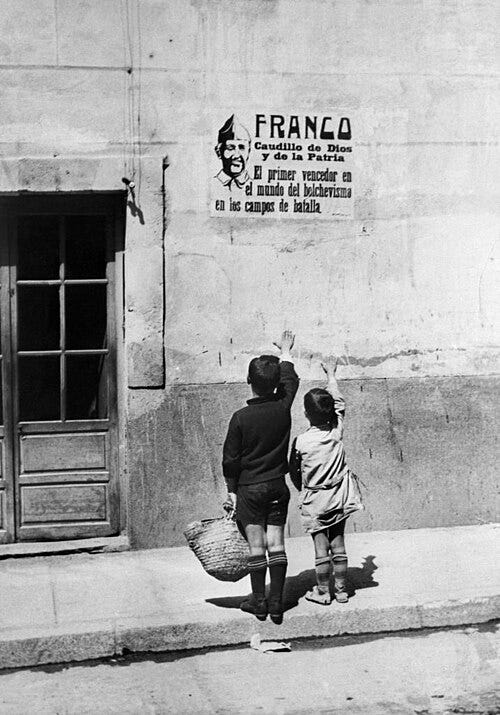
When, in 1926, the war against the Rifkabyls1 ended in victory and Spanish Morocco was pacified, all of Spain cheered a man whose contributions to the victory had been duly rewarded: Colonel Francisco Franco, just 34 years old, whom the king had promoted to general in a special, out-of-turn promotion.
The youngest general in the Spanish army, born on December 8th, 1892, in the Galician port city of Ferrol, was originally destined by his father for a civilian career, but had chosen a military career in defiance of all opposition; he had graduated from the War College in Toledo, served as a young officer in various high-risk posts in the perpetually turbulent region of the Rif Kabyles, and had earned his first spurs through outstanding performance.
With all the enthusiasm that a southern temperament is capable of, the people cheer Franco on: no one, however, suspects that the cheers are for a man who, ten years later, would become the liberator and savior of Spain.
In 1931, the king was overthrown, and Spain became a republic; General Franco thus came into conflict with the new government because, as a guardian of order, he refused to lend support to the revolutionary mob, which resulted in his arrest, conviction, and assignment to a penal battalion in Morocco.
When, in 1932, Franco’s teacher and fatherly friend, General José Sanjurio, attempted an uprising in Seville to restore the monarchy, Franco, with a heavy heart, refused to support him, explaining that his work was not dedicated to the republic or the monarchy, but to the welfare of the people: when it came to the people’s welfare, he would always be there.
This reveals an attitude to which Franco remained steadfast in the years that followed: he adhered to it again when, in 1934, the government called upon him to crush the uprising of the radical Reds in Asturias, which ended in victory—he saved the Republic from slipping into the hands of the Commune and became Chief of the General Staff.
Barely two years later, however, in February 1936, the Commune took control of Spain with the help of the “Popular Front,” inspired and directed by Moscow; one of the government’s first acts was to transfer Franco to the Canary Islands as a punitive measure.
The Popular Front is in power, terror reigns in the streets, corruption spreads: Moscow calls the shots, and general strike and world revolution are the watchwords.
Arriba España—rise up, Spain! The welfare of the people is at stake, and General Franco does not hesitate to answer the call; he allies himself with the like-minded generals Emilio Mola Vidal and Luis Orgaz Yoldi, who are joined by Queipo de Llano.
Joining these allies from the army—setting aside their differing political ideals—are the “Falanga Española” under Don José Antonio Primo de Rivera, the traditionalists under de Fal Conde, and the “Renovación Española” under Calvo Sotelo, with the immediate goal of liberating their homeland from the terror of the red mob.
The assassination of Calvo Sotelo by the Red police gives the signal: General Franco lands in the homeland with Moroccan troops.
Throughout the country, the well-meaning rise up, but above all those who have made the work of national renewal and rebirth their cause: at the forefront are the fascist Falangists, whose leader—imprisoned by the red arsonists—was to become, after months in prison, a martyr for the rebirth of his people.
Supported with money, manpower, and supplies from the rulers in Moscow, the Madrid branch of the Comintern, known as the “Popular Front,” organizes the bloody resistance against the noble forces of the people - a path of suffering then begins for unfortunate Spain, where all the forces of the underworld are unleashed: murder and arson, destruction and devastation mark this path, the end of which is still not in sight even today.
The national uprising grants General Franco unlimited powers as head of state, and the General announces his program: the task is to rebuild Spain, to ruthlessly eradicate Marxism, to rally the nation’s vital forces, and to forge them into a national community - the task is to create the conditions for a new Spain of order and social justice.
In a grueling, sacrificial struggle against Moscow’s mercenaries and the segments of the population they have misled, Franco and his followers are gaining ground step by step: most of the country has been liberated, and everywhere the liberators have been greeted with enthusiasm, while the Red arsonists have been driven back to Catalonia - now the decisive battle has entered its final phase.
While the Red rulers—recognized as such by the people they had misled—are losing ground; while they surrender themselves to the mercy—or lack thereof—of the puppet masters in Moscow; while they are transferring Spain’s gold reserves abroad to secure a carefree emigration just in case, and while they have scaled back their once-soaring hopes to the cry “No pasaran!” — “They shall not pass!”—Franco, with unyielding energy, is forging the path that leads to the liberation of the fatherland.
Beloved by the people and strengthened on the international stage by the recognition his government and he himself have received from Germany and Italy, he is preparing to deliver the decisive blow - yet the others, too, are not sitting idly by.
Moscow continues to send money, supplies, and soldiers, and while the Popular Front in France is even considering open intervention on behalf of the Marxists, the others—led by England—still refuse to recognize Franco as a belligerent power.
When the work of liberation is complete, when calm returns to long-suffering Spain, Franco’s work will still not yet be done, for the liberator from the red yoke will then become the leader of the people, under whose strong hand the monumental task of national rebirth and renewal will be undertaken.
Among the forces participating in General Franco’s national uprising and his crusade against Bolshevism, the national and social renewal movement of the “Falange Española” occupies a leading position.
The movement, whose full name is “Falange Española de las Juntas de Ofensiva Nacional Sindicalista,” was formed in February 1934 through the merger of the fascist association “Juntas de Ofensiva Nacional Sindicalista” (JONS), and the “Falange Española,” founded in October 1933 by José Antonio Primo de Rivera, a son of the well-known dictator of the same name.
The movement’s program is based on the principle that the ethnic groups of Spain form an indivisible unity: it calls for the abolition of parliament, the establishment of an authoritarian government, the dissolution of political parties, the eradication of Marxism and class struggle, and the organization of the state along corporatist lines; it opposes pacifism and Freemasonry and demands the separation of church and state and the subordination of the clergy to national interests; finally, it rejects the traditional privileges of individuals or entire classes, as were customary in Spain, and demands that its followers commit to a Spartan and heroic outlook on life.
After its founding, the Falangist movement gained ground only slowly, even though it had already suffered its first blood sacrifice at the hands of Marxist terror as early as February 1934; it did not experience a tremendous surge in popularity until, following the electoral victory of the Communist “Popular Front” in February 1936, anarchy increasingly spread across Spain.
The more fiercely the Marxist terror raged, and the greater the number of Falangists arrested and imprisoned by the Popular Front government, the more the country’s youth flocked to the movement in droves: now, today, some 120,000 Falangist militiamen are fighting in Franco’s nationalist army, and the number of organized members of the movement is estimated to be several times that figure.
The movement’s leader, Primo de Rivera, who had been arrested even before the national uprising, was shot by the Red authorities in Alicante in November 1936; now Manuel Hedilla currently heads the organization, and he has established his headquarters in the immediate vicinity of General Franco’s in Salamanca.
Although military tasks are currently the priority in light of the bloody war against the Reds, the “Falange Española” has, in the name of practical action, begun to put into practice its long-prepared plan for the future reconstruction of society and to work toward the realization of its political and social goals.
Within the framework of its Junta, it developed a corporatist organization of the working people with special groups for employees and employers, which it refers to as “national syndicalism” in contrast to anarcho-syndicalism; meanwhile, the majority of Spanish students were brought together in the Falangist organization known as the “Sindicato Español Universitario”.
The Falange devoted particular attention to the organization of agriculture, for which a detailed plan for its corporatist restructuring exists: land reform—which had been severely neglected but was desperately needed—is now to be carried out in the form of the colonization of large estates, with the latifundia owners planned to be compensated with a fee set on the basis of the relatively low yield of the land, before their estates are to be divided up and settled by small farmers and farm laborers - in this way, a new peasantry is to emerge in Spain, and the sins of past centuries are to be atoned for.
Thus, in the midst of the immense work required by the war effort, the “Falange Española” is already engaging in the great work—the work of shaping a new and better future—to address pressing social problems; at the same time, however, it does not fail to take the urgent needs of everyday life into account with the utmost vigor, and it plays a leading role in organizing a large relief effort, as well as in fundraising drives and soup kitchens modeled after the German example.
Alongside the Falangists’ national renewal movement, a number of conservative, reactionary, and democratic groups are also fighting against communism in General Franco’s army, the most significant and powerful among them being the movement of the Traditionalists, or Carlists, who for a century have tenaciously championed the interests of the line of Don Carlos—who was excluded from the line of succession in 1830—and advocate a program aimed at maintaining the Church’s rule and introducing the principles of the papal encyclical “Quadragesimo Anno” into Spanish public life; they are followed, in terms of membership and strength, by “Acción Popular,” which advocates a Christian social-democratic program, and “Renovación Española,” which advocates for the return of Alfonso XIII.
Fears have been widely expressed that the diversity of forces within Franco’s camp harbors the possibility of a future conflict between conservatism and reaction on the one hand, and the leader of the army and the national renewal movement on the other: it is to General Franco’s great credit that he recognized this possibility in time and took preventive measures.
On April 19th, 1937, he formed the Falange Española Tradicionalista y de las JONS. (Juntas Ofensivas Nacionales Sindicalistas), which was designated in a decree of August 4th as the party that would henceforth form the foundation of the Spanish state: at its head stands the Head of State, General Franco himself, assisted by a National Council composed of a senior army officer and one leader each from the militias, the Falange, and the Requete.
The Carlists, as guarantors of the continuation of the historical tradition, and the Falange, as the designated architect of the national revolution, are the driving forces of the Spanish National Party, which is composed of active members and supporters; in addition to members of the Carlists and the Falange, other active party members include generals, staff officers, officers, and noncommissioned officers of the Army, Navy, and Air Force, as well as individuals who have been exempted by personal decision of the movement’s leader.
Supporters may become active members upon the party’s recommendation within a period of five years; without this appointment, their status as supporters expires.
The militias were also merged into a single organization under the party’s name, which are to serve the Falange in both war and peace and form a bulwark against the internal enemy: their leader is also Franco. Meanwhile, all other militias, like the political parties, were dissolved on April 19th, 1937: this ensures a unified expression of the will of the entire Spanish people, both today and in the future.
Today, everyone stands unconditionally behind the General, committed not only to fighting Bolshevism, but also to striving for the realization of a national and social renewal program announced on October 1st, in which the question of the future form of government—monarchy or republic—has been left open for the time being.
For more than a year, a bitter civil war has been raging across the Iberian Peninsula—a war between the forces of a European principle of order and a non-European principle of destruction - it thus seems, as it were, a quirk of history that Spain, of all places, has become the scene of a bloody struggle between true Europeanism and non-European Bolshevism—the very same Spain that, through the fault of the Church and the kings, untouched by the Renaissance and the Reformation, slept through centuries of European development; the very same Spain that, until recently, still seemed irrelevant to European development. Today, decisions of European significance are at stake there, for it is by no means irrelevant to Europe’s development whether the peninsula beyond the Pyrenees, through the victory of Bolshevism, will be transformed into a stronghold of non-European, Soviet aspirations, or whether, through the triumph of national counterforces, it will become what must be the wish of all good Europeans: a new Spain, a bastion of European order and culture; a new Spain whose formation will proceed in the spirit of the national and social renewal efforts of the “Falange Española.”
From “Die Welt vor der Entscheidung” (The World on the Brink of a Decision), published by the Supreme SA Leadership in 1938
An indigenous Berber tribe in Morocco who established a short-lived independence movement before their defeat in 1926. - The Translator