
"Offensive Art"

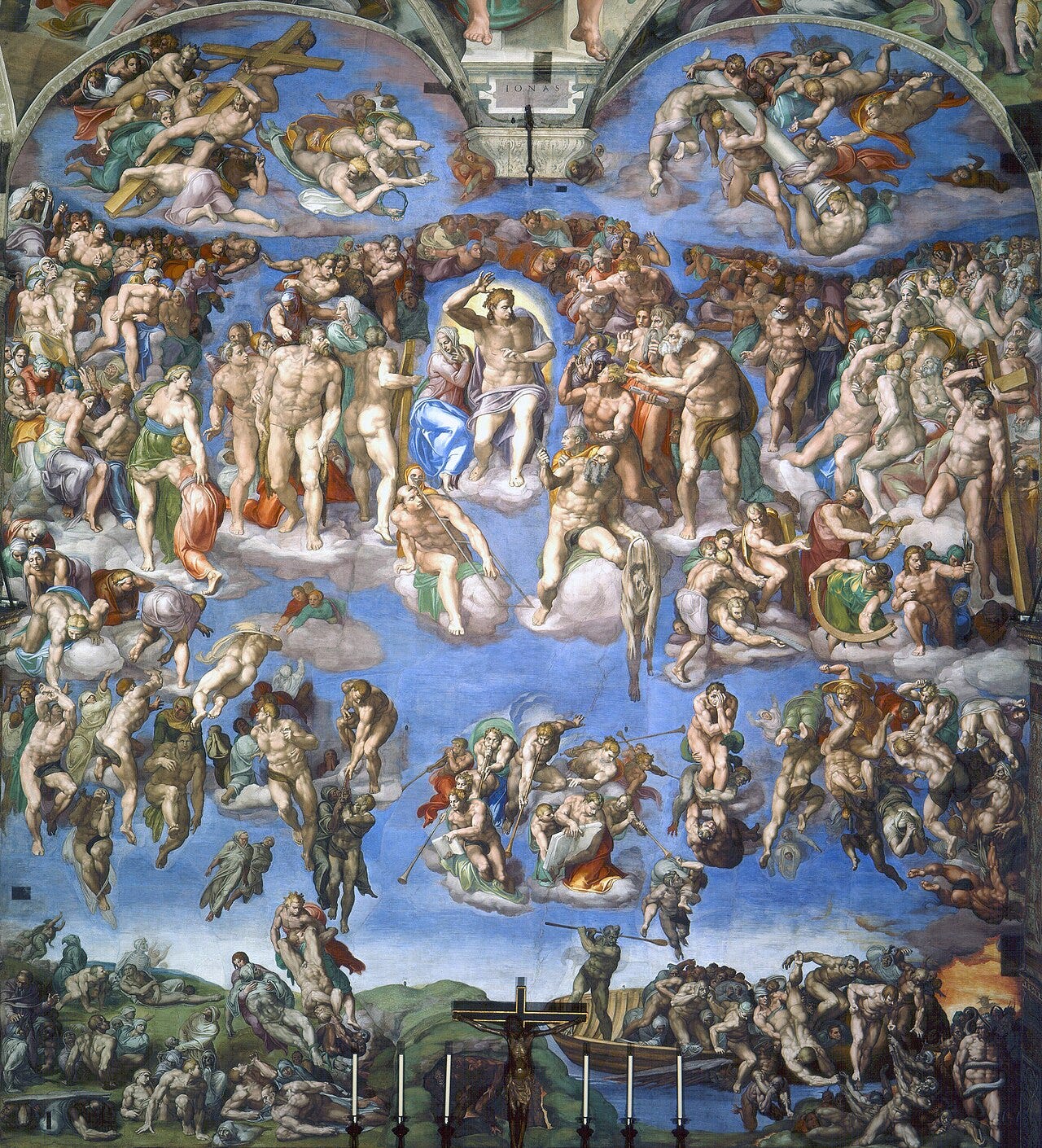
The civilized world of the continent and the West was taken by surprise some time ago by a report in The Times, which stated that the Holy Father in Rome had commissioned the Italian painter Biagio Biagetti to add pants and veils to the figures in Michelangelo’s frescoes in the Sistine Chapel, so that Catholic notions of modesty would no longer be offended by the exposed body parts; it was further reported that the Pope’s representative had already erected a massive scaffold and begun the work, which was supposed to be completed shortly before Christmas.
In the meantime, the Vatican has denied the report, claiming that from the very beginning the intention was merely to restore the areas that had become damaged over the centuries: we are unable to verify the accuracy of this denial, but it seems beyond doubt that there is currently no intention of allowing Michelangelo’s unique works to be defaced by small-minded people—for who else would agree to undertake such work?
It was interesting for us to observe the reaction to The Times report, for certain sections of the foreign press, which never tire of expressing outrage over the barbarism and cultural ignorance of National Socialist Germany, were suddenly left speechless: they completely forgot to express outrage over this true cultural disgrace, and even the Pariser Tagblatt of Mr. Georg Bernhard, who otherwise certainly does not skimp on verbal insults, could muster only “extreme bewilderment”, something which art lovers around the world would also greet this “moral measures” from the Vatican.
This leniency, as I said, is worth noting, especially when one recalls the frenzied outcry those same people raised in the name of the community when, after January 30th, 1933, Germany had pyres erected in public squares to burn the wildest monstrosities of foreign thought that had influenced our people for years.
The report in The Times thus once again draws attention to the chequered fate to which the great master’s murals have been subjected over the centuries, and while the Catholic Church is particularly fond of emphasizing the lessons of its 2,000-year-old history, we, too, can learn from this—namely, that a remnant of that spirit we tend to call the Middle Ages has not died out to this very day.
Perhaps the greatest artistic genius of all time, Michelangelo, crowned his life’s work with a monumental painting that covers the entire altar wall of the Sistine Chapel: the very same room whose high groined vault he had adorned at the age of 33 with those creations that represent the most magnificent achievements monumental painting had ever produced, was now to be transformed by the sixty-year-old artist into a tabernacle of Christian humanity, in which he would bestow upon the ceiling fresco depicting the Old Testament—which, so to speak, encompassed the sacred space within itself—a symbol that represented the ultimate expression of the New Testament.
The great artist—or rather, the pope, who was well advised by him—chose for this purpose a depiction of the Last Judgment—a monumental undertaking that simultaneously required the visualization of Christian conceptions of eternal bliss as well as the prerequisites for it, namely the Christian virtues.
On the Day of Judgment—that is, on the day of the resurrection of the flesh—all earthly things fall away from those who are entering either eternal bliss or eternal damnation: just as it once emerged from the Creator’s hand, humanity stands before its Judge, naked and bare.
This is not only a matter of course in artistic representation but also a theological and ideological prerequisite: the assumed equality of all human beings can hardly be expressed more simply and vividly than precisely through the absence of clothing, for otherwise, depending on the tastes of the time or the artist’s perspective, the painting—intended to be timeless—would inevitably have been confined to the era of its creation, quite apart from the fact that even the tiniest scrap of clothing or, indeed, period-specific attire would necessarily have revealed social or class distinctions.
The seemingly bold decision to adorn the most sacred chapel of the Papal Palace—conceived as the center of Catholic Christendom, the place where the “Vicars of God” are elected—with an image depicting the saints and the damned, and even the Eternal Judge, naked, was thus a well-considered one.
Neither the Pope nor the cardinals consulted had the slightest objection to Michelangelo’s artistic approach, for Paul III, the last pope imbued with a truly humanistic spirit, was fully aware that the Sistine Chapel would become the most revered place of pilgrimage in the world in the future—not only because it was the Pope’s main chapel, but also because of the masterpiece by the greatest painter in human history - after all, having just ascended to the papacy, he had urged the master with great impetuosity to begin his work, exclaiming: “For thirty years I have longed for this day!”
He knew that his name would long since have been forgotten, like that of many other popes, were it not for the fact that his commissioning of these paintings would save him from oblivion.
Nevertheless, there was no shortage of envious critics and naysayers who raised their voices immediately after the artwork’s completion, and even while the work was still in progress, the papal master of ceremonies, Biagio, had remarked that the many nude figures violated propriety—and doubly so in such a consecrated space.
Michelangelo took genuine artistic revenge in return: he placed the impertinent critic in Hell as a judge of the dead, and the pope took great delight in this pointed joke.
But no sooner had Paul IV ascended to the Holy See a few years later—a pope who, as the chief architect of the Catholic Restoration, sought to reestablish the medieval condemnation of the body—than the voices multiplied that saw the nude figures as a threat to public morality.
Unlike his namesake, Paul IV failed to recognize that Michelangelo’s figures, by virtue of their towering artistic grandeur alone, possessed the most dignified garment conceivable: he ordered the entire painting to be whitewashed over, and it was the objection of a large number of cardinals—and ultimately that of the emperor—that saved the threatened sanctuary of humanity.
Faced with the storm of indignation provoked by his barbaric iconoclasm, the Pope felt compelled to content himself with painting over particularly “offensive areas”—that is, the lower abdomen of nearly all the male and female figures.
It was not entirely easy, in an era when art was generally appreciated, to find a man willing to commit such a shameful act, and for the elderly Michelangelo, who had to live to see this insult to his most exquisite work, had not held back on his scorn: “Tell His Holiness that a painting can easily be altered; let him rather change the world!”
Finally, one of Michelangelo’s students, Danielo Rieciarelli, volunteered to drape the naked figures in garments; he then proceeded as gently as possible, and took years to complete his work, always hoping that a change would come about after Paul IV’s death - however, the subsequent popes, too, insisted on continuing this disgraceful work.
Since Ricciarelli had clothed the saints too scantily, he was replaced by Girolamo da Fano, who completed the unfortunate task - thus, through this activity, both men acquired a nickname that was far more enduring than their painting, as they came to be known simply as “trouser painters,” and as such they have gone down in art history.
The trouser painters had, perhaps out of respect for the master, used paint that did not last: in the 18th century, when the gloomiest pedantry and a world-renouncing aversion to the earthly realm dominated the Vatican, this disgusting crime against the most precious treasure of Western culture was repeated in a truly hideous manner; for now, heedless of the destructive effect, garish Baroque colors were introduced into Michelangelo’s somberly harmonized symphony of colors.
Rightly so, when scholarly art history began to study Michelangelo in the last century, every generation of researchers was outraged by this desolate barbarism, and repeatedly and emphatically demanded the restoration of the painting to its only worthy form—namely, as the master created it.
A Nordic creative spirit produced these works of art—a man who proudly (whether justifiably or not is open to question) considered himself a descendant of a Lombard count and a German emperor; they were created in a powerful era that looked down upon cowardice and weakness, and that saw itself as the rebirth of antiquity, but above all as a bright dawn after the dark night of the Middle Ages.
We view the Middle Ages differently than the people of the Renaissance, but we agree with them in that, like the ancients, we regard the healthy human being, with healthy senses and a healthy mind, as the foundation of the state: just as the Renaissance did, we condemn all backward-looking bigotry that seeks to perpetuate the medieval defamation of the body—this most terrible ideological danger.
The denigration of the body has, as anyone with eyes to see—including the Pope—can observe, produced political consequences that today can only be eliminated with a sharp sword, for what is the Red Terror in Spain if not the natural consequence of centuries of subjugation of the physical and mental health of a people who, as a result, have forgotten that moral standards must be rooted in what is human.
If Spain is now, just like Italy twelve years ago, entering a new, vigorous era, the most important and fundamental change will be that the physical training of youth is based on a new, ideological foundation: the body and its senses are no longer, as they were during the centuries of ecclesiastical rule, frowned upon and “offensive”, but are once again what they were in classical antiquity—the foundation of a strong, self-assured national character.
The Latin nations have it easy, for they can build upon the tradition of Roman greatness, which has never entirely died out, and in this way will soon overcome the political insignificance to which the decline of their physical culture—and thus their heroic spirit—condemned them in the past few centuries: as the example of Italy has shown, a turnaround and rise require very little time.
Nor do we fail to recognize the great mission in world history that, particularly during the centuries of the Middle Ages and the Renaissance, made the papacy and the Church the custodians of the cultural heritage of the classical world: we, too, owe a great deal to the achievements and creative vision of the Church leadership of that time in the form of the imperishable masterpieces of the visual arts, created by the will to power and the artistic sense of responsibility of great popes - however, this bond, which—despite all other differences—has connected us to the Catholic world to this day, will be severed if, at this moment, petty barbarism lays hands on the most precious treasures that humanity possesses.
We, who are so often and so readily labeled “barbarians” by the Vatican—we appeal to the cultural conscience of the world! Do not destroy what can never, ever be recreated with equal value, and have reverence for the only power that unites all people: the eternal beauty of art.
From “Anstößige Kunst”, published in “Weltanschauliche Betrachtungen” (Reflections on Worldview) by Heinar Schilling, 1938, originally featured in Das Schwarze Korps, 1936.