
"The Competitor: America"

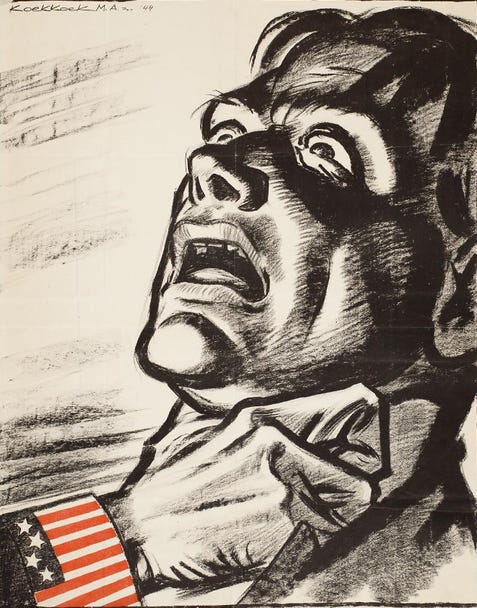
America’s Position
America occupies a special position in the postwar era - in this era of general powerlessness, America alone is endowed with unquestionable power, meaning that America’s power is also a problem: if Europe is the defeated party of the First World War, then America is undoubtedly the clear victor.
America is the one non-European nation that has reaped the greatest benefits from the war - that is but one consequence of the outcome of the First World War for America, but at the same time, America has also taken the place of Europe’s former hegemony in the world; now this former European hegemony has been shaken not only because America has grown stronger, but also because new powers are rising in the spheres where Europe once held sway.
By inheriting Europe’s former hegemony in the world, America has thus also inherited the upheaval of that hegemony - here, America also shares in Europe’s defeat, and this is the other side of the outcome of the First World War for America: if the European states now seek to preserve their de facto lost hegemony in the world through the League of Nations, they are, in effect, only preserving American hegemony.
Here, peculiar and seemingly mystical comparisons can be drawn between the race of the American population and the political position of the American state:
The population of America is composed of European races, and a new race is forming in America from this racial mixture - just as the American population is composed of European races, the American state is now assuming the former global standing of the European states.
This global standing, however, seems to have been shaken at its very roots, just as the rule of the white race seems to have been shaken at its very roots - with the realignment of the world’s political power centers, America will indeed lose its global dominance, but it will likely still remain a world power among world powers, just as a new race is emerging in America alongside other races; after the loss of the European races’ supremacy in the world, America will then be, racially and politically, a continent among other continents.
If we said that the present age is a transitional one, then America exercises Europe’s traditional supremacy even through the means of this transitional period, but not through the means of state power, for as far as the formation of tightly organized state power is concerned, America is not a state in the European sense.
The state that is only now taking shape there under current conditions will be as different from those in Europe as those under which new power is forming in other non-European regions of the world - in this sense, America is still a colonial territory.
The American state is still committed to a limited liability partnership with its citizens, even as a distinct national consciousness is already emerging in America alongside the formation of a distinct American race - at present, however, as far as the foundation of state power is concerned, America is a peculiar mixture, just as everything in America—the racial composition of its population and the foreign policy stance of its state—is peculiar.
On the one hand, we see the wildest form of capitalism in America, and even in its milder forms, it has already had a state-corroding and state-dissolving effect on European nations.
The spirit of American capitalism has a good deal of the trapper’s spirit and the leather-stocking spirit in it: individualistic expansion and the ruthless extension of the individual’s sphere of power, by any means necessary! The trapper did not see himself as a citizen of a state in our sense, and to the extent that the American capitalist is a trapper, he is just as little a citizen - therefore, the entire American economy is carried by this type of capitalist, which cannot in itself be state-forming.
Here, America as a state is still a limited liability company: it is recognized as a state as long as it serves personal advantage and is a means to personal advantage.
America is vast and rich, and it took a long time before political demands began to impose disadvantages on the individual that exceeded the advantages granted by his membership in this limited liability partnership that is the American state - the size and wealth of the American land thus act as a state-forming force for America in relation to these trapper-capitalists.
Space, however, narrows as the individual expands, and once space has become confined, has a new, strong sense of statehood already developed from the broad strata of the people—one that holds the American state together as it is without major upheavals, therefore further consolidating it?
In any case, America now exercises its hegemony in the world not as a state, but as an economy - we have already said that with the end of the First World War, America had taken the position of world hegemony in place of the European states, and we have further said that this hegemony is internally undermined; we also indicated that America exercises this hegemony through economic means.
However, since purely economic power, if not upheld by state power, is hollow at its core, this may also serve as an indication that America’s position as a world power is hollow; the fact that America exercises Europe’s former hegemony purely through economic means may also provide further support for our interpretation of the present era as a transitional period.
The European states ruled politically through power, and with this power they made the world subservient to them; America, by contrast, does not take their place as a power, and it even allows their old forms to remain, as it possesses only economic utility and economic superiority - therefore, the next stage for the great regions of the earth would be economic independence and their own political power.
Future historiography could organize its material according to the following perspectives: through their technology and the capitalist economic order based upon it, the European peoples conquered the world, allowing them to attain political and economic supremacy; in doing so, they also awakened the world and created new forces within it that took up the struggle for freedom.
Due to its fragmentation into various states, and due to the historically inherited, excessive emphasis placed by European states on their own nations over Europe as a whole, Europe lost its supremacy with the First World War.
In this era of global economic interdependence, ushered in by Europe’s economic exploitation of the world, global supremacy shifted to the strongest economy: America. However, since the consolidation of the state in America had not kept pace with the expansion of the economy, America could not sustain its economic power through state power - that is why the world also broke through America’s economic supremacy.
The “Power of Gold”
Despite the individual economies’ ties to the world market, each economy functioned as a self-contained unit in the prewar period: each of these economies had its own specific structure and composition, and goods and services were exchanged with one another based on these specific characteristics.
This exchange took place with the aid of money, and the purchasing power of money—setting aside inflation and the like—fluctuated with the economic situation; the economic situation and the purchasing power of its money were closely linked for every economy.
Gold was not necessary for the exchange of goods and services within individual economies, but it did become necessary as soon as individual economies entered into relations with one another, since deficits were settled in gold and surpluses were received in gold: gold was the form in which individual economies built up reserves to cover obligations in less favorable times.
Even then, however, it was not necessary to peg the currency to gold, allowing a means to be created to compare the value of services supplied to or received from abroad with those within the country; this in turn made the goods and services within the various economies comparable in terms of value, creating a fixed standard for the respective economic conditions of the individual economies in relation to one another.
When the individual economies eventually became somewhat dependent on gold through the pegging of their currencies to it, gold still did not become the sole determining factor for any of them, for, relative to gold, the individual economies remained strong as economies - it is true that within an economy, the purchasing power of gold could fluctuate with the economic situation, but if the fluctuation became too severe, countervailing forces immediately set in.
For example, suppose a country’s exchange rate fell: then, first, that country’s exports—which may have been suffering from export barriers—were revived, for one received gold prices for one’s exports and could pay domestic expenses with money whose value had fallen relative to gold; the discount rate was raised, interest rates rose, and money flowed in from abroad.
While, from a theoretical perspective, the rise in interest rates is difficult to reconcile with the promotion of exports through reduced costs amid a decline in the value of money, the balance of the gold standard could always be restored in times of peace, for the individual economies regarded themselves as interdependent in terms of production and markets, thereby balancing each other out - together, they had spontaneously formed the world market.
Its internal composition corresponded to the internal strength of the economies participating in its formation - thus, through the movement of gold, the world market was able to sustain the strength of the individual economies.
A comparison for this type of relationship among individual economies can be found in the general formation of communities among people - when people form a community, the level of that community is the average level of its members, and each member is influenced by the community to maintain their original level: thus, in the pre-war period, gold was the expression of the communal relationships among individual economies, and together, they gave gold its value.
The quantity of gold and conditions of production, on the one hand, and the purchasing power of currency units, on the other, did not come into constant conflict; the internal and external purchasing power of money coincided - now, however, it is different, for this community has been torn apart, and gold has become a master rather than a means to an end.
Through its power over gold, America has the ability to separate the movement of the external purchasing power of all other currencies from their internal purchasing power: the external purchasing power of all currencies is now equal to the internal purchasing power of the dollar in America.
Currencies are no longer measured against gold, but against the dollar - whereas the internal purchasing power of currencies used to be largely independent of their external valuation expressed in dollars, it is now dependent on it.
And yet, through their peg to the dollar, these currencies offer the advantage of being stable among themselves - is this advantage greater than the disadvantage that arises alongside it?
The fundamental difference from the past lies in the following: while previously the movement of exchange rates depended on the movement of goods (in which gold, too, was a commodity in this respect), the movement of gold was inverse to the movement of goods - if more goods (for simplicity’s sake, let us assume here that interest income, etc., constitutes the payment for goods) entered a country than were exported, gold flowed out, and vice versa; now, the movement of gold in relation to America is detached from the movement of goods, and the movement of gold now runs parallel to price movements in America.
In relation to foreign countries, the movement of gold for America is a movement of credit - suppose prices rise in America: then, as a rule, there is a lot of money in circulation there, but then in consequence there is also no increased quantities of goods coming to America, for instead, the money flows out to foreign countries as credit - thus, foreign countries do not sell to America, but may even continue to buy from it.
These credits inflate the economy abroad, the productive apparatus is expanded, and the credits from America increase the money supply.
In America, too, the money supply was large - however, part of the excess money now flowed out of America and created inflation abroad; in America, the excess in the money supply—inflation—was mitigated by causing inflation abroad.
Suppose America now tightens the discount rate - for America, the effect of the rise in credit costs is mitigated to the extent that American loans are now being called in from abroad: there, the rise in the cost of credit imposed in America now takes full effect.
Meanwhile, the production apparatus abroad has swelled during the period of abundant credit, and we now have here investments in real assets that must be liquidated, but cannot be liquidated - a situation similar to the one we in Germany witnessed with horror now follows the period of inflation.
Inflation in America is inflation of the gold currencies, and deflation in America is deflation of the gold currencies.
Before the war, every state conducted its own monetary policy; now America can set monetary policy for all states: that, in essence, is power—overwhelming power.1
The Folly of the Americans
In a naive form, admittedly, but no less implausible, the United States of America has in mind nothing less than the economic subjugation of the world!
We do not casually label these manifestations of American will to power as “naive”, for their premise is that man has become entirely a businessman and that his sanctity is the sanctity of business: indeed, it is a naive premise.
Here the state—here the economy: the Americans affirm the economy first.
If Marxism is, at its core, less a social critique than above all the greatest conceivable affirmation of the economy over the state, then the Americans are the true Marxists; they know man only in his connection to the economy and its system, but not in his freedom as a man, of which the state is the expression.
Ultimately, the global economy is now the “American economy,” American power: the folly of the Americans lies in their belief that the power of the check will forever be stronger than the will to live.
A Break from American Thinking
German nationalism will remain alive only if it reshapes the world - it must realign its thinking with the foundations from which alone a German victory can arise, which means breaking free from the constraints imposed on us by “economic thinking.”
“Economic thinking” is American thinking: it is the seal of the empire’s subjugation, for this thinking is an acknowledgment of Versailles, which was created from it.
No people is more compelled than ours to free itself from this American thinking, if only because for no other people is the pernicious temptation toward it as strong as for ours: we see how strong it is in the smug satisfaction of democracy with its “spirituality,” which is nothing but the temptation to call such servile thinking “fate” - it is unfortunate that people believe it and believe in its “realpolitik.”
In all other nations, alongside this “global economic thinking” lies state power thinking - that is what they wanted to smash in Versailles, and that remains its deepest blow!
What others possess in terms of real foundations of the state’s will to power—which make state power thinking appear “realpolitik”—we must replace with unconditional faith in a new idea of power - in this sense, we must set faith and will against regiments that are already formed.
This is for the best, for this is how the spirit of the new age arises among us in its purest and most purposeful form! Thus we first and most profoundly overcome Marxism, which lies at the heart of global economic thinking, for then we will then have the most steadfast fighters.
This shift in thinking is made easy for us by a harsh fate, for the global economy now means competition among the natural wealth bases of economies: we have barren, cleared land and an almost absolute shortage of raw materials, and coal, our only raw material available in significant quantities, is constantly being displaced by electricity and oil - on this basis, are we supposed to compete with the richer countries and be able to feed our people, when every German move triggers an outcry in the countries that feel threatened, who call for restrictive measures? Are we to operate on this basis until our advantages in technical superiority—which perhaps still provide bread today—are leveled, and we are left empty-handed, with no one to fill our hands with bread?
They are coming up, the hordes, these “vingt millions de trop” who are condemned to death so that the sentence may be carried out - but will they allow it to be carried out?
This question encompasses smoke, a field of rubble, turmoil, murder—and final decline—if they must allow it to be carried out.
But if we have changed our minds in time, if we have envisioned new goals and new paths, then these “vingt millions de trop”2 will fight alongside us for their very existence: no longer against their own countrymen, whom a competition mechanically extended from the world market into our own economy makes appear as enemies, but with us for the Reich!
From “Neuordnung in Europa - Gedanken eines Wirtschaftlers” (Reorganization in Europe - Ideas of An Economist) by Fritz Nonnenbruch, 1939
This describes, when it was originally published in 1925, the global economic crisis of 1929.
French colloquialism for “twenty million too many”, when discussing an absurd sum. - The Translator