

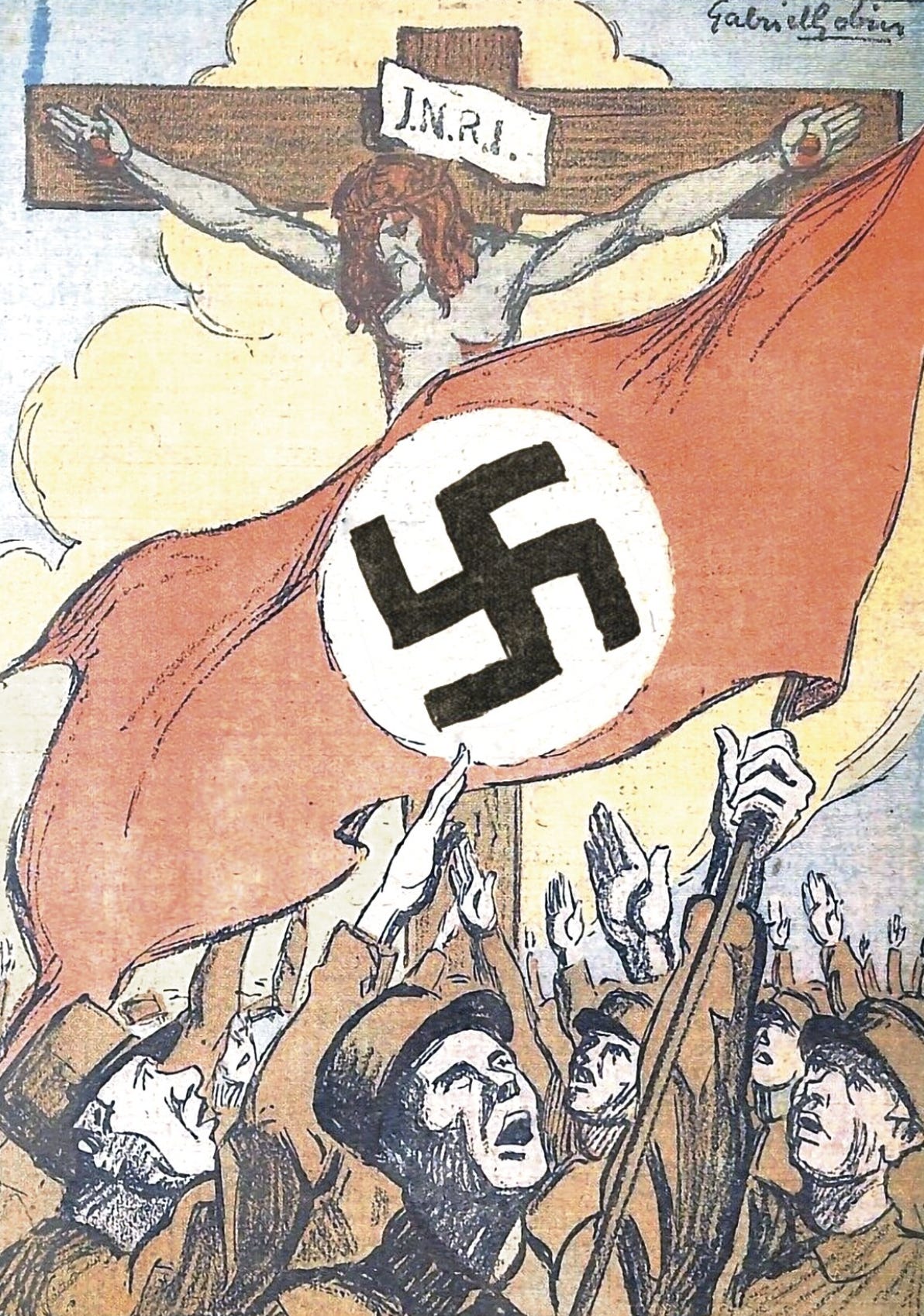
Our attitude toward Christianity as a whole is one of a sense of reverence, grounded in the fact that our fathers and forefathers lived and died in the many forms of Christianity - now, Christianity itself is following them into their graves, which is a process of truly tragic, yet world-historical significance.
However, if we detach ourselves from Christianity as a whole today, this is not malice, as theologians of all churches and sects will explain, but rather the honest expression and culmination of a development that has become increasingly clear since Luther.
With the triumph of Protestantism, there was no longer any tangible Christianity, and with the emergence of the thousands of sects within and outside of Protestantism, the disintegration of even this great reform attempt on biblical grounds became evident; finally, the growth of the atheistic movement into the form of organized world Marxism has demonstrated the inability of Christianity as a whole to guide souls and humanity.
Without the spiritual awakening on a racial-national basis, the further development of these conditions would have led to the violent destruction of all churches and the extermination of their representatives: Bolshevism was the dress rehearsal for this new twilight of the gods.
Christianity in its entirety rejected National Socialism as the decisive saving force of Europe, and passionately opposed, slandered, and denounced it as heresy; therefore, it is not surprising that the Roman Catholic Church allied itself with Marxist treason in order to defeat German nationalism.
This alliance began in 1918, continued for fourteen years, and persisted until the Second World War; indeed, even after 1939, through pastoral letters from its bishops and public speeches, it left no doubt about its fundamental and mortal enmity.
In this clear historical situation, we no longer need to discuss whether a “pure doctrine” still exists outside of all churches and sects, though we may have tried to find one ourselves in our youth - but it is not for us to invoke once again the few sayings of the founder of Christianity that still seem related, for they are no longer sufficient for spiritual support and comfort: their content is exhausted, and their religious power is gone, because it has been proven that the salvation of the German people came from the depths of their blood against historical Christianity, which is the only real fact we have to deal with.
We have given all churches twenty years to try again for reform, but if Christianity has become so detached from life that it cannot see such possibilities, but even zealously opposes these generous proposals, then it has passed judgment on itself before the whole world: whoever misses such opportunities must not be given them again, because he has proven himself unworthy of them.
In the willingness to still value, indeed defend, a certain religious attitude as positively Christian, it became increasingly apparent that, over the course of more than 1,000 years, we had given Christianity so much of its Germanness, its Europeanness, that we perceived much that we primordially viewed as Christianity, when in fact it was essentially only German, and European in general: the alloy seemed to be uniform, but under the hot breath of a great revolution, the metals are now melting, and the elements are beginning to separate from each other.
Thus, with sharpened instinct and the clearest awareness, we reclaim what we have given to Christianity, or rather, what it has appropriated, in order to drive the strongest possible roots into the German, European essence, which, despite all inquisitorial efforts, cannot be eradicated.
Christianity rejects racial doctrine: fine, we want to consider and evaluate it as raceless, nationless; Christianity teaches the indissoluble bond with the Old Testament: fine, we want to leave it the ancient Jews and their Bible, along with all those who today wear the Jewish star in Europe as worthy descendants of Abraham, Isaac, and Jacob; Christianity still teaches the literal virgin birth, the descent into Hell, and the ascension to heaven of its founder: fine, we want to leave this attack against all European science in its book; Christianity rejects pride, combativeness, and soldierly behavior as contradicting the doctrine of love: fine, we want to acknowledge servility as now purely a form of Christian morality.
We therefore understand the author of the Heliand more as a Germanic than a Christian; we see in Rainald von Dasse today merely a figure borrowed from Christianity; we see that Walther von der Vogelweide, from this perspective, was an Antichrist, like Hutten—even if they themselves were unaware of it, and only intended to combat the papacy initially.
Luther’s phrase about the “mighty fortress” is an outrageous expression of German character, and “God’s Son with curly hair” is an anti-Christian Germanic image that has absolutely nothing to do with the crucified Christ, or even with the hysterical saints.
The blonde Madonnas were painted for wealthy church patrons, but they are not testimonies to Christian “monasticism,” the celibate priests, the “virgin” women; rather, they are testimonies to fruitful life, and they should all be called “Mother and Child.”
Christmas should be seen as a family celebration, and Easter, as a spring day, are no longer hours for remembering Oriental legends, but German festivals: separating the customs of our farmers from purely Christian ones will be the task of the coming decades.
We are happy to acknowledge auricular confession, probabilism, veneration of the stigmatized, etc., as belonging to Christianity itself; however, Christianity owes its richness, strength, vibrancy, and connection to life solely to the Germans and Europeans, and now that this uprising has been met with a campaign against Germanness and an alliance with Judaism and Marxism, the German people not only have the right, but the duty, to reclaim their gifts.
What one rejects, one should not impose upon one’s guests, as self-respect demands this.
Christianity has been a guest in Germany for just over 1,000 years, yet its representatives have often abused this hospitality, ultimately insulting the host and threatening them with robbers: now the rights of the host are being restored.
This is the simple, yet self-evident demand, yet we are nevertheless well-disposed towards the unruly guest, for we know that in earlier times, conversations with him helped to awaken many a fighting spirit that might have lain dormant for a very, very long time.
We also remember that our ancestors revered and loved the guest and richly endowed him with goods: we honor this attitude of the past by neither beating nor persecuting the guest, but he simply has no more business in our house; in fact, he has already left the hall, and it is necessary to note that he no longer lingers in the back rooms, waiting for another time to take his place at the master’s table and feed himself at his expense.
We recommend that the guest seek out countries where they emphasize that he is especially loved: we have nothing against him being taken in and cared for with love, if it is consistent with one’s own nature, but we do not want another Thirty Years’ War, nor another November 9th.
We have not forgotten these lessons, and do not want to stand once again in inner turmoil before our burned-down house.
Substitute Religion
With a palpable triumphant undertone, the German renewal movement is asked, in light of some understandable uncertainties on the part of the churches, what it intends to put in place of Christianity as a “replacement”.
There are crucial points to be made regarding this question, which still causes so much consternation - above all, no one should separate themselves from the Christian churches, and that means from Christianity itself, if they later feel a longing for it or seek a “substitute” for the values and philosophy of life of Christianity: one has only truly freed oneself from a past when, after overcoming it, one possesses a feeling of freedom, not a feeling of helplessness.
We certainly don’t want people who still have one eye on Peter and Paul when they have simultaneously declared themselves ready to serve the Eternal in Germanness: the “apostate” should feel like someone who, after a long illness, can finally get out of bed again, and while this person may still feel pain in all their limbs, and may still wobble a little during their first attempts at walking, they no longer feel a longing to get back into bed as a sick person.
Christianity as a Mental Illness
Christianity has indeed been a serious illness of the German-Germanic people: such religious wars and persecutions of heretics would never have been possible within Europe if Christianity had arisen naturally and organically from the blood and soil of our region.
Just as the healthy forces of a body afflicted by illness struggle against dangerous germs, so the German character struggled with Christian ethics and metaphysics: this struggle has sometimes emerged in an exuberance of the will to assimilate, and thus neutralize, i.e., immunize, and at other times it has emerged with the will to expulsion.
Assimilation was the will of Protestantism against late Roman corruption; expulsion, however, is the will of the 20th century.
This will is the spiritual reality of our time, and it is therefore only desirable that the half-hearted remain within the churches: we take no pleasure in them because they will always cry out for “replacement,” i.e., they are backward-looking sick people, yet within the churches, they accelerate the process of general awakening.
In 1941, many were astonished by the ferocity with which the Bolshevik army defended the existence of the Soviet Union, as it had been assumed that the inmates of this giant prison would revolt against the guards when they learned that forces had been assigned to remove them.
However, the opposite proved true: the imprisoned and mistreated prisoners defended their cell guards with an astonishing ferocity.
The quintessential Russian, who usually does something quite different from what a European would have done under the same circumstances, behaved most strangely this time as well: plundered, humiliated, and tortured, he believed that the opponents of Bolshevism were even more vile, more depraved, even more exploitative, and that his prison was still more dignified than the states of the “fascists,” and thus they lashed out wildly when attempts were made to free the poor wretches.
This is exactly how Christians behave today after a thousand years of subduing.
Racial instincts have been lulled to sleep by incense and Bible reading, and heretics have been burned or left to rot in prisons for centuries: only gradually has an awakening from the Christian chloroform slumber begun, and now the process of clear-headed healing is beginning.
But those whose fathers and mothers were once persecuted and destroyed, like Bolshevism did to the fathers of today’s Soviet soldiers, are precisely the ones who cry out that they are being robbed of their most precious possessions when they are reminded of the moral absurdity of still speaking of resurrection and ascension in the Copernican system: they say that their salvation is threatened when honor and self-respect are placed higher than subservience and feelings of original sin.
Blood and honor have been awakened to full health, but the teachers of shame and grace praise this elephantiasis of the soul with almost perverse zeal as the exemplary nature of a divine commandment for the German people - but the heretical wars are the judgment of world history upon this Christianity.
In contrast to today’s pilgrims to Rome of all denominations, we, the awakened and healed, can make the following observation: that Christianity has been the substitute religion of the European peoples.
Now that those who were first healed have regained trust in their own nature, in fate, and thereby experience providence and faith in God anew, from within, they need neither Peter nor Paul; they furthermore do not seek Jesus Christ, who was once a great figure and still is today, but no longer represents a religious figure for us - Jesus Christ is, after all, the man of the crucifix, and his festering wounds, his pain-distorted limbs, are historical symbols of the great spiritual sickness of Europe.
Those who sought the life of Jesus Christ searched with the probe of the healthy, and here they often found themselves - but that was never enough in the long run, for the crucified one was precisely the defining characteristic of Christianity: that, after 2,000 years of development, is what truly matters, not our touching, centuries-long attempts to heal this tormented figure.
These attempts, in which we all perhaps participated at some point before the moment of full relief from our own healing, have come to an end: a millennium has passed, and we do not wish to denigrate it, nor condemn it.
In the struggle with, for, and around Christianity, not only have countless lives been lost, but forces have also been awakened that might otherwise never have reached their full potential; however, the fact that we were able to venerate the crucifix was a sign of severe mental illness.
Eternal Germanic Values
Today, as we recover, we seek other images to shape ourselves, both internally and externally: while Wotan, Thor, Balder, and Freya have died, the values of the soul that lived within them could not perish.
These values sometimes encompassed Christianity and made it, at times and in places, tolerable for the Germans: that was until, in 1918, Roman Christianity allied itself with the blatant betrayal of all Germany, its present and future, with Marxism, and then turned in all its churches against the only movement that strove for a German rebirth - thus did the day of deepest humiliation already become the hour of crisis.
To die from Christianity and Marxism, or to recover through Germanness and Germanic heritage: this, and no other, was the fateful question facing the German people in the darkest days of their history.
National Socialism, as a symbol of overcoming Christian ways of life and belief, hated the disease out of joy at its growing recovery, but only after gradually and carefully examining the pathogens - in doing so, it found that those germs of infection that went through German life were wearing red caps, violet shoes, or black gowns.
Perhaps none of them were even aware of the danger they posed to the body politic, and indeed, some even honestly believed that they were acting “beneficially” when they denounced the advocacy of racial healing as anti-religious, pagan, and materialistic - but what was decisive in the course of a historical illness was not the individual, but the direction of his influence, which was determined not by him, but by those who had shaped him.
Wotan, Thor, Balder, and Freya are returning today, but in entirely different forms than when they once strode through Germany:
Wotan: that is the inquiring, earth-conquering spirit, as it has taken shape in a thousand great figures of Europe; unconcerned with churches and altars, he beheld the macrocosm and interpreted the microcosm.
A picture of the world has emerged over these 1,000 years of a breadth, penetrance, and depth such as never before, if we understand it correctly: it was worth sacrificing an eye for this experiential wisdom of 1,000 years.
Thor: that is the German knight and soldier who conquers space and earth to bring bread and freedom to the people.
Despite all setbacks, German strength has still been able to wield the hammer, and today has acquired the sword as well: the German people are no longer ashamed of this fact, as they were in a time when priests and pastors claimed the kneeling faithful as their “soldiers.”
In airplanes and on armored vehicles, Thor’s successors now march out today to defend hearth and homeland: they are no longer ashamed of this, as if they were committing a sin, but are proud to be able to protect the great Reich.
Balder: that is beauty and youth awakening anew, for from musty robes and hypocritical gowns, the beautiful, strong human being emerges once more, and in a new form of art, he rejoices again in the balance and order of his existence.
As Apollo, Balder had remained alive even among Christians and humanists, without being completely extinguished by the Christian monks: now we can calmly call Apollo Balder again, for he was merely his lost, forgotten brother.
Freya: whoever robbed the gods of her presence forever robbed them of immortality - today, however, the still-young racial soul has awakened to fertility once more, meaning Freya has returned from a distant imprisonment.
In the Germanic woman’s soul of our time, she has taken her place again with her will, to secure the immortality of the blood once more after such a long poisoning: she and her rebirth are the prerequisite that Wotan, Thor, and Baldr will not perish ever again; her powerful presence should also prevent a Hödur, born of bastard blood, from reintroducing parasitic plants into the Germanic land.
We still have no name for Wotan, Thor, Balder, and Freya today, but in the rhythm of awakening life and in the discipline of today’s Germans, they all live again a life that is quite eerily vibrant for all Christians: they march with our solemn soldiers into the field and tell them that they must fulfill a great destiny; they go with our singing youth into the forest and rejoice in their health and strength; they inspire the thinker of our day to cast off one garment after another of the old sick getup of the mind, and to loosen one bandage after another from our paralyzed will; they instill in us the love of beauty and racial renewal, and help us to make 1,000 years of monastic life forgotten.
Wherever we look, a great sigh of relief sweeps through Germany, which has remained Germanic - thus, in honor of Balder, stadiums and temples of art are built; thus, in honor of Thor, soldiers build the houses of their manhood in the freest nature; thus, in honor of Wotan, halls of a new scholarship and genuine wisdom will one day arise, and thus, in honor of Freya, mothers’ and children’s homes flourish, and the Germanic racial soul is embodied in the circle of German girls and women.
Above all, the cross of the martyred no longer towers, but the swastika banner, the symbol of the sun and creative power, the parable of eternally rising, ever-renewing life, now waves triumphantly over all of Germany.
Positive Values of the Founder
If one asks whether, through Judaism, Paulineism, and Hellenism—apart from the undoubtedly Germanic values—something has been handed down to us that, going directly back to the founder of Christianity, appears positive to us, then we may quite openly mention two aspects: one is love, and the other is the individual.
“Love one another” was evidently a new sound in Galilee, and it also appealed to a noble sentiment in Europe - thus, regardless of what the churches may have made of it, it remains for us, incorporated into a new order, a positive element.
Furthermore, the life of Jesus of Nazareth was surely a commitment to a faith, as he bore it alone and proclaimed the value of the personally purified soul: then he was murdered.
However, the fact that Paul and the Petrine Church, along with all the African and Syrian church councils and Jesuits, turned this into a system of personality extermination is one of the bloodiest grotesques in world history, which Luther was only able to partially correct.
We can be free enough to acknowledge this “positive Christianity”, but the rest is inwardly dead, and must be cast off if we are to be healed; to even see a religion of the Christian kind, reaching into the metaphysical and awakening from these two values, seems improbable.
The idea of personality has been lived and exemplified by so many Europeans that they are closer to us and more akin to us in their severity and attitude than Jesus Christ; alongside this, while we gladly wish to see love cultivated as a personal feeling, it must submit to the values of honor and loyalty to the nation, for only together with these will it be able to provide a religious foundation, thus finding its prevailing, all-human meaning altered.
The religion of the future will perhaps be the only refuge where true values can still find meaning and effect; meanwhile, in the “Christian” churches, the entire Jewish-Syrian-African Orient will remain.
Rome’s Hatred of the Racial Worldview
For all these reasons, what is otherwise incomprehensible to many becomes understandable: that the Roman Catholic Church hates the racial worldview more deeply and bitterly than skeptical liberalism and atheistic world Marxism.
While Freemasonic liberalism was certainly perceived as an enemy, and a whole roster of Catholic writers depicted the Satanism and moral depravity of this “counter-church” in lurid colors, after the liberal separation of church and state, Rome gradually calmed down, for it increasingly recognized that while liberalism could at times be politically inconvenient, it essentially lacked religious formative power and, through its loose political-parliamentary structure, allowed ample room for the revival of Roman influence: it was purely individualistic, and therefore not a dangerous ideological opponent.
The same applies to Marxism in its social-democratic form, for it, too, is not an organic entity, but merely the external summation of so many millions of individuals; it essentially does not form a community, but rather a mass, which is why this word was so beloved by our Marxists.
It was foreseeable that, barring unforeseen catastrophes, the spiritual emptiness of such a worldview would leave the more deeply searching individual just as unsatisfied as the outward forms of parvenuism would, and very soon provoke rejection - for Rome, therefore, it was essential to strengthen the sense of belonging wherever Marxism could truly become dangerous, naturally without allowing it to “degenerate” into nationalism in Protestant countries.
The Center Party in Germany was tasked with implementing this policy of the Church, with the conservative subdivision through the Bavarian People’s Party: while Bavaria was a predominantly Catholic state, and therefore a strategy of preserving the core identity was necessary there, Prussia, on the other hand, torn apart by red fervor, was to be weakened at its Protestant core to such an extent that it would no longer be able to muster any energy against the red-black coalition.
The “Brighter Future” triumphed in 1931, and seemingly—before the victory— the abdication of the Protestant Hohenzollerns paved the way for the “re-Catholicization” of Germany.
In Russia, as the same journal noted, Bolshevism had provided the opportunity for Catholicization: that is to say, they openly expressed their joy that the centuries-old rival of the Greek Catholic Church had been slaughtered by Bolshevik Judaism, and the thousands of murdered Russian priests are thus considered happily eliminated competitors.
Rome’s calculations seemed to be correct at the time - suddenly, however, the enigmatic German spirit, as it had 400 years ago, raised its head and threw all clever calculations overboard.
Of all places, in Munich, a man appears who awakens the German soul, which was thought to have been happily strangled in Versailles with the joyful approval of Pope Benedict XV; the people listen intently to this man, and more and more followers gather around a new sign with an ancient symbol of salvation; even the black treason and the church bullets at the Feldherrnhalle cannot prevent the rise of this movement, which is completely incomprehensible to the Romans.
For a time, they underestimated National Socialism as a sectarian party like so many others: they had already experienced bursts of antisemitism, and (in Vienna) had even made it subservient to Rome as long as it seemed expedient to use it as a political tool.
But Rome and the Romans had miscalculated, for up to that point, they had bought everyone through political maneuvering, and they no longer understood that a people could have a genuine conviction, deepened into a new faith; then, when they truly began to understand it under Brüning, it was too late.
With inner horror, Rome now saw the jumbled atoms of Germanness coalescing, as if under a mythical force, into an ever clearer form.
Service to the People and Honor as the Highest Values of the Soul
Belief in the supernatural and metaphysical speculation will mean little to our century: this century searches for values: it does not ask about bliss and reward in the afterlife, but is convinced that service to one’s people and honor represents the highest good of the soul.
If there is a metaphysical center, God, then such a life will necessarily determine its immortality; if, however, this center does not exist, then one has lived proudly, which must also suffice for proud people.
With liberalism, a foundation of previous Christianity also collapses: both are individualistic, atomistic, and selfish; both see only individual beings, whose sum is supposed to constitute humanity, the “communion of saints,” etc, and both have uprooted people.
From the standpoint of Christian selfishness, there is no just world order because nature and war destroy millions of individuals: no scapegoat theories, nor heavenly hopes can remedy this today.
Fate can only be understood from the perspective of the people: the tree must be judged not from the leaf, but from the root and trunk; this is the national rebirth after 2,000 years of selfish poisoning.
No one of the living generation can fully experience this rebirth because they are atomized by liberalism or Christianity; only a generation that has known nothing else from its youth can live the wholeness of the people as the starting and ending point of the individual’s existence.
From the manuscript “Religion und Kirche” (Religion and Church) by Alfred Rosenberg, sometime after June 1941
The authour of this piece is obviously working out of a un-nuanced way of thinking. He does not understand the theology of Christianity close to what is necessary for such a long article. He already rejects any supernatural happening, or how the bible could actually be true. He presupposes too much about Christianity and thinks that Europeans invented Christianity. No-one invented Christianity. The main carriers of Christianith may be European because they, because of their surroundings and that people are different, are more inclined to understand the gospel, but that does not mean that anyone who is ignorant (like the author who works from a lens of hatred and already made up mind of Christianity. The Christianity he thinks of is not Christianity, just his idea of it) is too far from grace. National socialism comes FROM Christianity, never the other way around. However, he does concede that Christianity gave many great things to Europeans. I agree. But that does not mean that he can suddenly barrate the faith. It does not mean that he can be a divisive element within the movement. The Christians who ally themselves with Jesus-hating atheists aren't Christians. He thinks that most if not all Christians and Christian institutions support this. We don't. Do not make Christianity or National Socialism out to be something it isn't.
Hitler is, as you know, a very fair man. He will give positions of power to those who are capable. It does not mean he agrees with everything they say; eg he did not like/appreciate Goebbels amd Himmler's pagan-ness. I do know that Rosenburg does not advocate for atheism, but his worldy, unsubstantiated view of Christianity makes me not want to read his book; because all I will be consumed by is rage. Do you maybe have a brief thesis on his views? I do know of positive and negative Christianity, even though it is slightly flawed.