
"The Philosophical Foundations of Bolshevism"

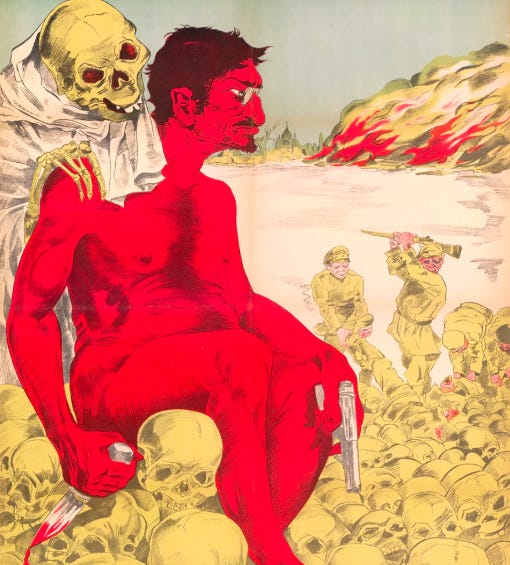
Every political movement and every historical development has its origins and foundation in the writings and thoughts of those great visionaries and sages who were ahead of their time and their people by as much as a century: Rousseau and the French Revolution, Nietzsche and Schopenhauer as the precursors of our current German generation, and the visionaries of Bolshevism and communism:
Tolstoy and Dostoevsky
At first glance, these last two figures seem to be polar opposites of the current Russian era, particularly in matters of religion - both were Christians whose faith was marked by a depth of devotion and a thoroughness in following Christian doctrine that are characteristic only of the natural Russian people.
Of course, regarding Tolstoy, Mereschkowski—who once compared the faces of his great compatriots and contemporaries—says that he has a demonic feature, a face marked by coarseness, a face like that of a blind “underground titan”: it is this feature on the face of this man—who is anything but a Christian saint, but rather an old “pagan”—that haughty, impassive coldness that is generally the characteristic of great pagan men; meanwhile, of Dostoevsky’s slightly squinting eyes, the same author says that they are the “eyes of a prophet or of one possessed by a demon” - both works, however, are perfect reflections of a communist era.
The most obstinate programmatist of Bolshevism is, first and foremost, Tolstoy:
“Away with the barriers of education and the law, away with the barrier between rich and poor, away with all this so-called culture, away with all violence: away, therefore, with the Church, with the State! Pay no taxes, refuse military service.”
The Bolshevik has faithfully carried out all of this except the last point (refusal of military service); he has also slowly grown accustomed to paying taxes again, yet to this day he wants nothing to do with Tolstoy’s demand: “Become Christians.”
Tolstoy himself, who wanted to be, so to speak, Russia’s first communist, had of course no idea that his doctrine was nothing but lies and deceit, for he himself wanted to exemplify the life of a simple peasant doing the simplest manual labor to the astonished Russian serfs - this simple life, however, was nothing other than a completely new and unusual form of luxury, “an eternal feast, an eternal game,” since behind his back, his faithful wife, who did not think much of her husband’s teachings, managed his vast fortune.
Tolstoy, just like Dostoevsky, thoroughly depicts Bolshevik figures and characters in their stories: there is Nataschka, in whom one sees no soul, but only her face and her body, “a strong, pretty, fertile female animal”; everything human and personal is transformed here into the elemental, impersonal, unconditional, collective. The people in “The Kreutzer Sonata” and “Resurrection” also appear as horrific as the Bolshevik rulers.
Tolstoy, as the foremost Bolshevik, rejects all European art that preceded him as a forgery: Shakespeare and Goethe, Beethoven and Bach, Wagner—all of them are “frauds” (his book against Shakespeare is based on a complete ignorance of English history and literature) - this is a complete negation of all historical development and forms the basis of their cultural chaos.
The same is true of Dostoevsky - at the very moment when the old society, with its forms and goals, collapses, the “rising generation” is irresistibly seized by a criminal desire to set a conflagration ablaze: Dostoyevsky, the man “with the shadows of suffering and the wrinkles on his sunken cheeks,” the persecuted, the man who was sentenced to death, the revolutionary and nihilist (who later had a complete conversion), who says of his own dreadful life: “Who can say that human nature can endure this without going mad?” the man pardoned from forced labor in Siberia—this Dostoevsky truly has a claim, after the torments and sufferings of his life, to be called a Bolshevik.
“From the House of the Dead”—that is the title of the records of his “inexpressible, endless suffering,” for every hour and every minute weighed on his soul like a stone: he felt “buried alive, locked in a coffin.”
He calls himself a proletarian writer—his characterizations, his psychology, his depiction of humanity’s lowest dregs, his cruel dissections of the most horrific human conditions—what are they but faithful images of today’s Russian Bolshevism! Here, gruesome impulses awaken, unknown and unacknowledged feelings—this is the clear, dangerous, and direct path to Bolshevism.
The titles of his works alone say it all: The House of the Dead, Demons:
“Everything will become new, and then world history will be divided into two periods: from the gorilla to the destruction of God, from the destruction of God to the physical transformation of the earth.”
A long procession of degenerates, the neglected, the physically and mentally ill, the fallen, the insane, the drunkards, the tortured and the desperate, those perverted by sensual greed, the monstrosities and the cripples marches past our mind’s eye - here the prophet of Bolshevism, without shame and in naked revelation, heralds a new, a horrific era, whose fundamental chord is human torment and torture and the disenfranchisement of all that is divine: these are the first portents of a new culture, of a barbarism breaking in with full force.
Dostoevsky, incidentally a son of two homelands, Europe and Russia, coined the significant phrase for his time:
“Never before has Europe been so permeated with such hostile elements as it is today; it seems to be completely undermined, loaded with gunpowder, and waiting only for the first spark.”
Dostoyevsky inevitably becomes the leader of a revolutionary Russian youth, holding in his hand a terrifying light: Bolshevism.
No one knew and described the ills of his people as he did, and with prescience, he revealed the horrors of the coming era: he, the man of God, who had overcome Marxism within himself and, filled with revulsion, had spewed it out as a foreign body—he who sought to warn against it by painting a picture of its terrors—could no longer halt the course of events, for there was no one there who could have satisfied the longings of the Russian people and steered them onto the right path.
To read Dostoevsky is to experience and understand Bolshevism, and thus, the transformation of the Russian people into Bolsheviks unfolds consistently within his pages.
What has changed, after all? In the end, everything has remained the same: the Russian herd-man is now tormented and tortured not by the tsarist whip of yesteryear, but by the knot of the Bolshevik state commissar; the prison has been turned into a morgue.
Is there no danger for Europe? Nietzsche has already pointed out the dangers: they are to be found in the “introduction of parliamentary nonsense,” plus the obligation for everyone to read their newspaper at breakfast.
The Bolshevik Leader
Just as the characters depicted by Dostoevsky appear to us, so too do the leaders of Bolshevism - there is Lenin, with thirty years of deprivation, flight, persecution, conviction, exile, struggle, an assassination attempt, and finally death from syphilis—who holds the most peculiar view of his entire life’s work, saying to Gorky:
“The most astonishing thing about this whole story is that no one has yet been found to throw us out the door.”
Here we find the purely mechanical man who denies everything spiritual and divine: when asked “What is communism?”, he gave the curious answer:
“The Soviet Republic plus electrification.”
He is the technical and scientific experimenter for whom two million human lives are worth less than 100,000 horsepower:
“A single technician is worth ten communists.”
He is a keen observer of the will and motives of the masses; he knows that Russia is not particularly fertile ground for revolutionary experiments:
“Russia is a thoroughly backward peasant country, and therefore socialism cannot triumph there directly or immediately; this peasant country can, however, give the general upheaval a tremendous reach.”
Stalin too goes through a harsh school of deprivation and poverty - from a career as a clergyman (he was expelled from the seminary after two years), his path leads him to become a revolutionary; he is the typical “subhuman” and underground operative with his own distinctive traits: suspicious, distrustful, cautious, clever and cunning to the extreme, with a touch of the Jesuitical—all hallmarks of his underground activities.
He is the organizer of a band of robbers who kill people and steal money in broad daylight on the busiest streets of Russian cities; he is cruel to the extreme (he had 18,000 workers shot in three days), coarse, and devoid of any culture.
His incredibly boorish behavior toward Lenin’s wife earned him the latter’s enmity, and it was only thanks to Lenin’s stroke that he was not eliminated shortly before the first dictator’s death, but instead became his successor - in Lenin’s testament, the following is written about him:
“He is crude, disloyal, and prone to abusing power: he must be eliminated in order to avoid a split.”
Boundlessly self-assured and fully aware of his omnipotence, he has always been accustomed to domination and destruction; he wants to catch up with and overtake Europe and America, and is arming for a world war, even though the waves of discontent and despair among his own people are robbing him of nearly every chance of survival - this bloodthirsty man, this beast in human form, is Russia’s greatest misfortune and Europe’s greatest danger.
Nor does he care for ideas or communist ideals - he has lately and coldly turned his back on any communist utopia, and solely to secure his personal lust for power and position, he is turning wholeheartedly toward private capitalist tendencies - to quote him:
“Enough of your damned egalitarianism.”
From “Der Rote Krieg - Mutter oder Genossin?” (The Red War - Mother or Comrade?) by Hans Schemm, 1931
Tolstoy admired Mozart and Beethoven, and in his long stories, from Family Happiness to The Kreutzer Sonata, which is named after Beethoven’s violin sonata, he portrays how much he admired their music. Even in War and Peace, one senses this admiration. Tolstoy, in Anna Karenina, also opposed the emancipation of the muzhiks and supported the old regime, in which a landlord takes care of the land and the souls attached to it. Dostoevsky, on the other hand, in The Devils, warned people against revolutionary nihilism. This novel was a criticism of Bolshevism avant la lettre. In one way, these two great authors opposed the West because they thought the Russian soul was different, more attuned to the spiritual realm, and that the West could never match Russia’s spiritual level. This was a widespread idea in Russia back then, as it is now. However, Bolshevism especially attacked the spiritual being of Russia, and until the Second World War, it continued to do so. I think the author of this piece is understandably hostile towards Russia and its culture, and his hostility has beclouded his judgement.