"The Soviet Problem"

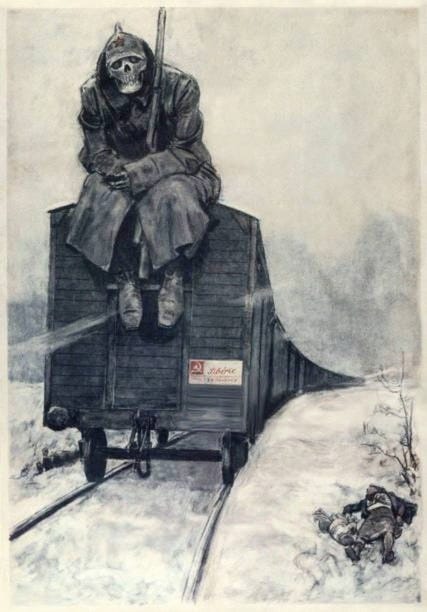
(From a speech by Reichsleiter Alfred Rosenberg to officers of the General Command in November 1943)
“To fully grasp the scope of today’s struggle, it is probably necessary to occasionally bring to mind the full extent of those forces—not only military, but also political and intellectual—against which Germany is currently fighting.
I believe that we will only be able to see the individual aspects of our time correctly and to place many of today’s measures correctly within a broader context once we realize that we are facing the convergence of all those intellectual and political forces which, beginning with the French Revolution, have come to us through the entire liberal, Marxist, and ultimately Bolshevik intellectual tradition; it is precisely against these final offshoots of the French Revolution that various peoples have risen up, or at least endeavored to cope with these Bolshevik manifestations, especially in times of collapse.
Germany, as the state that has fought these excesses of the democratic revolution most consistently, thus stands at the center of the entire world’s assault, for it is quite clear that whether it is Roosevelt or Churchill or any other leading figure of democratic states, they have all, like their predecessors, come to their positions only on a very specific basis, on the basis of certain doctrines regarding the state, on the basis of various economic ideologies, and with the aid of concentrated power; meanwhile, over there in the East, there is now a revolution—I would say, a very radical revolution—against another.
We will truly be able to understand this entire war only when we ourselves are deeply convinced that Germany represents both a revolution and a counter-revolution, and is now fighting to the death in the East against the most passionate advocates of the other side.
Especially in these last few weeks, very serious battles have once again taken place across the vast expanses of the East; all eyes are once again fixed on this struggle - there, I believe, the problem of the East has come alive again and again in all hearts. A myriad of questions regarding the history of this region, regarding the possible future intentions of German policy in this region, and regarding the nature and evils of Bolshevism have, of course, been posed to all of you, and you have presumably also debated these questions among yourselves very often.
I believe it is necessary, even as we wage this revolutionary struggle against Bolshevism now, to acknowledge that we are not merely dealing with the Bolshevik movement, but also with a problem that is many centuries old—the problem of the entire East in its traditional tsarist form of the past, ultimately, and even more broadly, with all those racial components and manifestations of will that have determined the fate of this region for many, many centuries; it seems necessary to me that we cast aside two, I would say, forms of hypnosis that have, to the greatest extent, shaped the historical perspective of recent decades, even in Germany.
The first illusion is the doctrine of a sole environmental influence, that is, the assumption that this region and its geographical milieu are ultimately decisive for all the historical phenomena with which we are dealing with now. It is certainly undeniable that this vast region has exerted a magnetic pull on the most diverse peoples. Between the Ural Mountains and the Caspian Sea, over the course of many centuries—perhaps even millennia—new waves of steppe peoples from Central Asia have repeatedly swept into Europe and, following military victories and through certain racial intermingling, have significantly shaped the character of this region; on the western side, too, this region has repeatedly demonstrated its appeal, for after all, the Indo-European migration passed largely through what is now Ukraine, crossing the Caucasus passes to reach Iran and India, while the Varangian and Gothic migrations, as a counter-movement against the steppe, also occurred in many successive waves; finally, the renewed attempt since Peter the Great to Europeanize this eastern region has been a sign of reshaping similar to that once brought about by the ancient Germanic conquests in this East. Furthermore, it is true that the currents of this region flow mainly from north to south, making the attempt to draw a border in a west-east direction therefore difficult, and that one could, in a certain sense, also understand a Russian theory that this region encompasses all the individual territories - nevertheless, one must be careful not to attribute the actual and decisive character to this environment, for there is, after all, a single plain stretching from Westphalia through Poland almost to the Urals, and on this vast expanse, crisscrossed by only a few mountain ranges, entirely different peoples ultimately live: the German people, the Polish, the Russian—all with distinct ethnic characteristics, with entirely different histories, and thus also entirely different cultures. The fact remains, however, that only one particular kind of people can turn deserts green, while another transforms flourishing forests into swamps and steppes; in the end, it is ultimately the human being who is decisive—the energy with which a person shapes their land and their environment; anyone who wishes to delve deeper and investigate will indeed find that Greece did not perish by chance, but that this people, too, was doomed not only as a result of interbreeding with Inner-Asian races, but also by the fact that these people, now also forced by external wars to cut down their ancient groves and, in place of the old, flourishing forests and meadows, ultimately received as their homeland a rugged, rocky landscape on which even ancient Greek civilization could no longer thrive.
The political hypnosis that shaped the view of the East was essentially the historical outlook of the old Tsarist regime - over the course of the last 200 years, this Tsarist regime was able to develop in an almost unhindered manner in all directions, and the Russian view of history declared this to be an entirely natural course of events; Russia was thus gradually reaching its natural borders, and over the decades, these “natural borders” were then pushed further and further: at first it was the Baltic Sea, then the Black Sea, the Caspian Sea; then came claims to the Persian Gulf, and by the end of the 19th century, Russia had indeed reached the Sea of Japan, with further aspirations then turning toward a free outlet to the Atlantic Ocean, so that the “natural development” of Tsarist imperialism was envisioned as a single empire, ruling over one-sixth of the Earth’s surface, bordering nearly all the world’s seas.
Europe could hardly hinder this development, and Europe found itself compelled to watch this development unfold, for Europe was so fragmented and divided by so many national conflicts that it possessed no political power whatsoever to oppose this development in any way, and so, particularly in the 19th century, Russia conquered Finland and the Caucasus after decades of fighting, Turkestan was conquered in the mid-19th century, and, as mentioned, the Russo-Japanese War demonstrated how far Russia had advanced eastward.
Germany now found itself in a position to largely accommodate the Tsarist Empire’s aspirations for power; under Bismarck, Germany could only establish the Reich against France, for France was at that time the hereditary enemy in the West, which for centuries had refused to allow the development of an independent German great power; Bismarck thus had every reason to secure backing in the East, and, as you know, he had indeed sought the best possible cooperation with the Russian Tsarist regime - however, the consequence of this political stance was that the entire field of German historical scholarship—presumably to avoid causing too many political difficulties—adopted the Tsarist regime’s entire historical ideology as its own, and thus, we can usually read in our history books that there actually existed a vast, unified space there, that Russia had gathered the Russian tribes in a natural development much as Germany united the German tribes under a single empire, and so people gradually forgot that behind the single Tsar lay fifty often entirely different peoples and races; one certainly did not deny their existence, but emphasized that they were merely small splinters, and meanwhile, for the rest, there was Russianness; one spoke of Great Russianness, Little Russianness, and White Russianness—indeed, a single entity with a single religious creed under a Tsar, and this unity was said to have grown naturally and must not be disturbed in any way.
Against this colossus of power, Western democracy had once staged the Crimean War in the 19th century, and you all know how sadly that endeavor ended, having succeeded in gnawing away at this great Russia in only a single place; Germany, in both 1914 and 1918, found itself so encircled that, while it did initiate the collapse of the Russian Tsarist Empire, it was unable to see this policy through to the end, having been weakened from within and betrayed from behind.
Today we once again face the task of confronting this eastern colossus in its hunger for power, and the question has been raised: did the National Socialist movement correctly assess Bolshevism; was it mistaken in any way; does it have reason to correct certain views, or has its assessment generally been correct?
Here we can perhaps highlight a few points that have been essential in our now 25-year struggle: we have stated that this Russian Revolution can certainly be explained by certain Russian circumstances, for a very complex process took place there - the Tsarist regime, partly influenced by Asian-style terrorism, was inept and corrupt, yet in some aspects of its leadership it retained a European character; the revolution against the Tsarist regime, on the other hand, was led by democratic professors, who thus also viewed from a European perspective and who thus directed their opposition against the Asian legacy of the Tsarist regime.
In the wake of this democratic revolution, however, a whole tangle of demands and human struggles arose, directed not against the Asian part, but against the European part—that is, the state-forming and state-building part of tsarism; this diversity and motley nature of the Russian Revolution was indeed its weakness in the first four to five months. This European weakness could not give this revolution a European character, and the chaotic movement has moved beyond these things; nevertheless, even if we take into account these circumstances of Russian and other peoples and their motivations, the form in which the Bolshevik movement developed was undoubtedly influenced by Jewish factors, not in the sense that we wish to assume that all of world history is the result of a Jewish conspiracy, but rather in the sense that, wherever a disease manifests itself in the body of a people, the Jew—as it were, as a symbol of such an exploitation of the disease—will, driven by his natural instincts, pounce on the wound to enlarge and deepen it - in the case of Bolshevism, we can now document how, even in Switzerland, Lenin surrounded himself almost exclusively with Jewish financiers and Jewish agitators, how the great Jewish financial establishment then financed Trotsky and sent him there—and here, too, Germany believed it could make use of this Bolshevik power to overthrow the Tsarist regime. The events in Hungary have further reinforced this argument: what we witnessed during the brief Council Republic in Munich reveals the same pattern.
The Bolshevik movement in Berlin, in all its radical or less radical shades, has undoubtedly been Jewish in origin for fourteen years, and so I believe it was not a misjudgment when we declared over these fourteen years that this Bolshevik movement is, in fact, as it is led and represented, a matter of a pan-Jewish world policy; I believe that we had no reason to revise this judgment, for even if at times Jewish influence seemed to wane, this is not a refutation of this position, but rather a confirmation of it - the Jew has not been a great military leader or soldier in his history, and if a number of Russian strongmen have emerged in the East today in the style of certain Bolshevik generals, then this is indeed a sign that Jewish intellectualism was unable to hold its ground against this primal force in this arena, and the dozen Jewish generals serve more as decoration, more than a bow to political power and not the result of genuine military competence.
The Internationale, as a global conspiracy, has supposedly been dissolved - in reality, however, it has been pulling the strings from Moscow, and here, too, no refutation has been offered.
When we said that Bolshevism had carried out a campaign of extermination against the peasantry and that the consequence of its policy must also mean the extermination of healthy peasantry throughout the world, I believe this assertion has proven correct, particularly in the East, for the collective systems were indeed designed to subject this entire vast peasant land to an industrial dictatorship in an ever-increasingly severe manner; from this perspective, the so-called Russian agrarian reforms are not at all a matter of agricultural policy, but are a very clear means of concentrating political power and breaking any resistance from the peasantry, which has very often made itself felt. In this sense, the tractor has not been a consequence of considerations of agricultural expediency, but a political instrument of power for the subjugation of the peasantry - if you take the horses away from a village and limit knowledge of a technical process to a small number of people, if you then keep this tractor under surveillance and make it available only to those who submit, then one can certainly say that a very consistent policy has been pursued here, and the result was by no means an increase in agricultural production through technology, but quite the opposite: the former peasant way of life and production was many times more productive than the entire massive expenditure of technical resources that the Soviet Union has undertaken over the past fourteen years.
We furthermore stated that there have been immense famines in Russia; millions, indeed tens of millions of people have starved to death and been deported as a result of this mismanagement - that, too, was true, and every farmer throughout the vast East will be able to tell you that time and again parts of his family were deported to Arkhangelsk, to the Urals, and to Siberia to promote certain large-scale economic ventures there, to cut down forests, and to establish mysterious industries; it is estimated that there were always eight to ten million political prisoners who had to work for free for the Russian state, and the dead were constantly replaced by new political suspects to keep the slavery going - that was correctly observed. That is why many were astonished when they found a great deal of extraordinarily healthy folk culture in this East; we may not have been able to picture this fact so clearly, but here, the law of life has once again come to the fore, a law that perhaps even we had not always fully grasped: the Bolsheviks had initially exterminated and driven away the best of the peasantry, bringing the lumpenproletariat to power; many incredible famines and diseases have swept through these plains, and the result has been the ancient law of existence: that the sick died first, and the healthy multiplied and survived. In these cold and harsh winters of the East, especially in Ukraine, we now find an exceptionally healthy population before us, and, notably, an interesting characteristic of the East: the women are all stronger, healthier, and more willing to work than the men; meanwhile, the men stand on the roadside, chatting as long as possible, and do not work very much; the women, endowed with a completely natural strength of health, have undoubtedly proven themselves here in Germany to be the very best foreign workers.
What we were likely mistaken about was the scale of Soviet armaments; here, secrecy was indeed largely successful, and the bluff—combined with a rather effective Bolshevik cover—certainly brought many surprises - in the course of these recent developments, as Stalin was now preparing to invade Europe, he made a remarkable shift in his policy—a shift that began to emerge in 1938–39 and is now being carried out in full force; at that time, one could already find a certain so-called Soviet patriotism in propaganda, that is, since the terms “Russian state” and “Russian people” had been outlawed, efforts were made here to promote a Soviet citizen who, above all other peoples, was to defend a new Soviet land and a new Soviet fatherland, and at the Bolshoi Theatre and several other theatres in Moscow and St. Petersburg, the drama “Kutuzov” was then staged as a symbol of the defense of the Russian land against a Napoleonic—that is, against any Western—invasion; Stalin permitted, as a trial run in 1939, that this Kutuzov cross himself on the open stage to the frenetic applause of the audience at the time. He then had a film titled “Peter the Great” made, which revived the entire concept of central Russian identity in a new form, with Peter the Great declaring: ‘What do the Western Europeans want from us? We are so modest; we only want our old Baltic provinces back’—with the clear realization that hardly anyone in Russia gave a thought to the fact that these Baltic provinces had never been under Russian rule. Then came the Finnish drama, and so on.
Step by step, Russia has pressed on in this war: it has reintroduced epaulets for officers; it has recently ordered that regimental flags, as in tsarist times, be received by the commander while kneeling; an entire fashion collection for the uniforms of marshals and generals has been published in “Izvestia”, and thus a process is indeed unfolding that Stalin was evidently compelled to undertake from within, in order to prepare, alongside a fanatical commissar regime, a development that would allow him to reconnect with old Russian history by leaping over a chasm of about a century - here, then, the slogan of defending the homeland, the holy patriotic war, has been proclaimed, and it goes without saying that in such a struggle, certain elements have also played into his hands.
There can be no doubt, however, about a convinced, fanatical Bolshevik leadership - over these twenty years, Russia has hammered out and shaped a primitive humanity; the memory of the past, of the better past, has gradually faded, and a class has grown up over these twenty years that was interested in the very existence of this Bolshevik state with its entire being. Undoubtedly, even in many Red centers, some workers were in a better position than they had been under the Tsar; the fact that they now ruled this country as a distinct class, that they were compelled to defend this form of government with body and soul, combined with a messianic disposition ever present in the Russian people, has produced a type of Bolshevik commissar who, let us openly admit, has surprised us in some cases - here, the old Dostoevskian messianic idea has allied and fraternized with another, atheistic and equally radical form in a manner that is downright perverse to us and our sensibilities; these Russian commissars, whose first and second echelons have surely all died by now, were at least able to put up extraordinarily tenacious resistance.
The Russian soldier has remained the same as he was centuries ago: a dull, at times extremely fanatical nature, ready to fight under a harsh command, yet just as ready—in the event of defeat or surrender after an hour, as many have indeed experienced—to shoot at the former commissars, explaining that they had always rejected them. The true Communists, however, have repeatedly told us when we asked them to explain their resistance: “We know that we have led a terrible life in Russia, but we have now sacrificed for twenty years and can already see the dawn of improvement in Russian life on the horizon; at its cusp, however, you fascists came to disrupt this peaceful development and subjugate us” - that was the propaganda slogan of the Bolshevik Revolution, which undoubtedly had an extraordinarily strong effect on the urban elements, and such fanatical leadership repeatedly forced the others to follow. The others declare: “You have come twenty years too early, for if we had continued working in this manner for another twenty years, only then would you have encountered a completely different, united resistance from our country” - thus arises the “justification” for the massive Soviet armament at the expense of many tens of millions of people who have been plunged even further into misery as a result; this likely also gives rise to the defenses, both through Soviet patriotism and through the call to defend the homeland.
Today, Germany stands as the sole strong opponent against this infernal force, as the defender of German and European culture and freedom.”
From “Das Gesicht des Bolschewismus”, edited by Fritz Sotke, 1944